
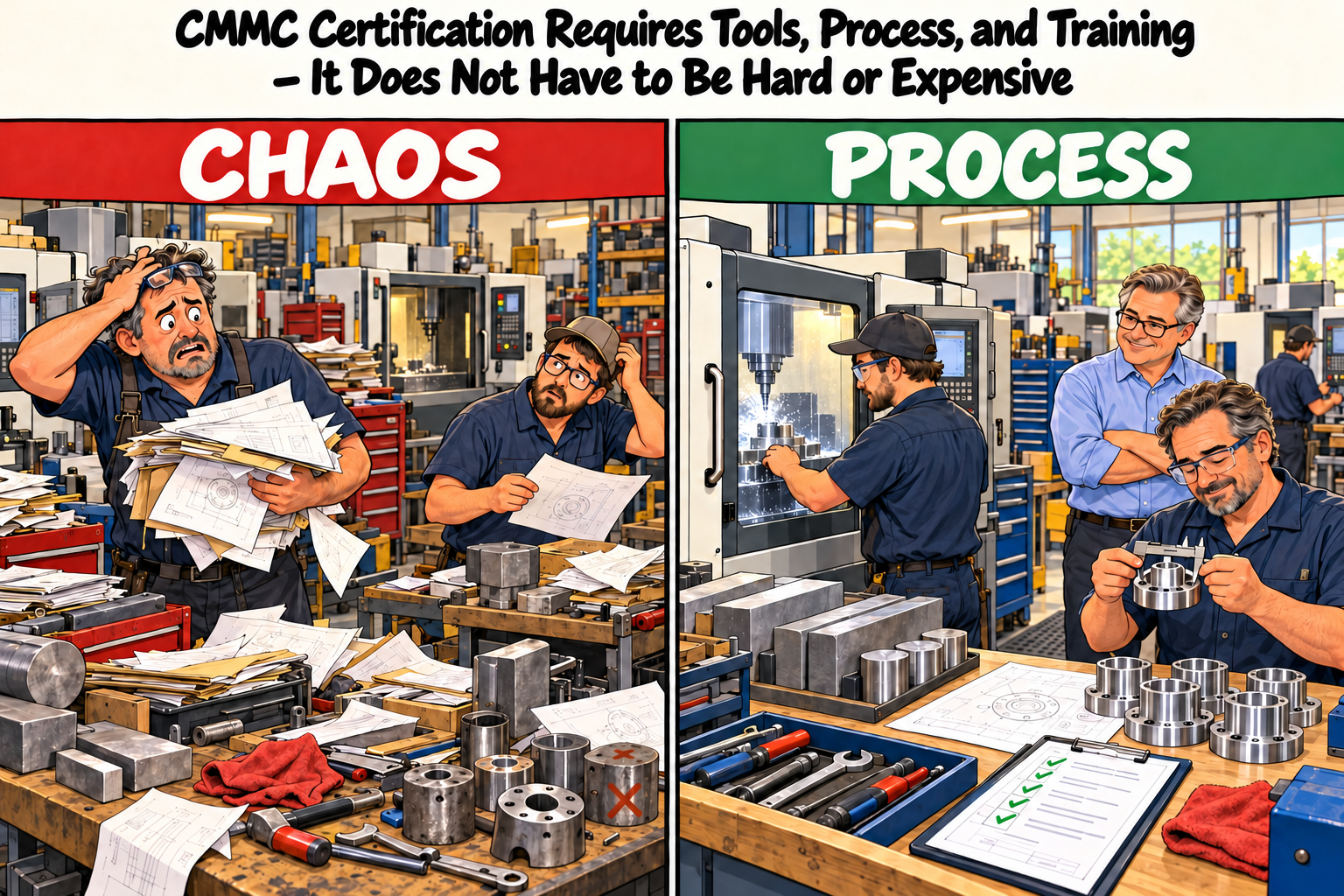
CMMC certification requires tools, process, and training. It does not have to be hard or expensive.
Put a skilled machinist in front of a poorly maintained machine, give them the wrong material and an outdated drawing, and quality will suffer.
A successful machine shop brings the right things together: suitable equipment, correct materials, clear plans, trained people, repeatable processes, and inspection. Each supports the others.
Cybersecurity works the same way.
Cybersecurity Maturity Model Certification (CMMC) applies that familiar discipline to your computers, business information, and the people who use them. Approached properly, it helps you run a safer, better-controlled business, and those benefits extend beyond government contracts.
Horror Stories
Stories of six-figure CMMC budgets are unsettling. In one published account, a business owner reported spending $100,000 toward certification and expected the total to reach $180,000–$200,000. The company was still working through the process and waiting for an assessment.
For a shop owner, the other concern is lost production. Picture your people setting aside their normal jobs to hunt through emails, collect screenshots, and rebuild months of records for an auditor. “This is not how we make money” is a reasonable reaction.
It is also reasonable to ask what the business gets for that effort, especially when certification itself does not put an order on the shop floor.
A standardized kit and process address the repeated work behind those concerns. Start with a working setup, train people to use it, correct problems as they arise, and produce the record during the work. That reduces time spent assembling disconnected tools, repeating checks, and reconstructing evidence.
Our focus is secure, repeatable operation. Assessment preparation follows the same process. Just as good setup, tools, material, and skill make fabrication repeatable, a security system that fits together makes the work easier to perform and explain.
You already understand the principles
The language of CMMC can make familiar ideas sound complicated. Consider the parallels:
| What your shop already does | The cybersecurity equivalent |
|---|---|
| Work from an approved drawing and job instructions | Establish clear rules for handling information and operating systems |
| Set up and maintain machines correctly | Configure computers securely and check that their settings remain correct |
| Fit guards and restrict dangerous adjustments | Limit powerful computer permissions to authorized people |
| Check out a machinist before assigning unfamiliar equipment | Train employees before giving them responsibility for sensitive information |
| Control materials and finished parts | Identify sensitive information and control where it goes |
| Inspect work against the drawing | Check systems against defined security requirements |
| Keep inspection results and job records | Keep evidence of checks, approvals, changes, and corrective work |
| Investigate a defect and correct its cause | Record security incidents, respond, and verify the corrective action |
Buying equipment alone does not create a capable machine shop. The equipment, people, instructions, and working practices must function as a system.
The same principle runs throughout CMMC.
Treat your computers like production equipment
Would you knowingly operate a machine with unsafe guards, unreliable settings, or adjustments anybody could change?
Apply that thinking to the computers supporting your business.
Start by finding out what is there: the systems, accounts, administrator permissions, and services that depend on those accounts. Identify standard administrator accounts, shared passwords, and permissions people retain throughout the day.
“Standing privilege” simply means someone keeps powerful access whether they currently need it or not.
For manufacturers using its Level 2 or Level 3 kit, AIC CMMC Complete™ helps discover that access and bring it under management. Your team gets a working picture of the environment and findings it can act on. Explore discovery.
Replace the password everybody knows
Suppose everybody on the shop floor knows the administrator password for every computer.
That is much like leaving the machine-control keys available to anyone, with no clear record of who changed a setting or why.
Replace that arrangement with an ordinary business approval process:
- Bring the administrator account under management and change the shared password.
- Update the services that depend on that password.
- Have the account owner remove unnecessary permanent administrator access.
- Require anyone needing powerful access to identify themselves and explain the job.
- Have the person responsible for the affected machine or production process approve the work and its timing.
- Let the approved access expire when its time ends, while retaining the request and approval history.
The maintenance technician can still perform an authorized job. The production owner has a say in work affecting the shop. Your organization has a record it can review.
That is useful operating discipline for commercial work as well as government work.
Train people before handing them responsibility
You would familiarize a machinist with a CNC machine or lathe they had never operated. That includes its controls, safety shields, operating procedures, and what to do when something goes wrong.
Handling sensitive information deserves the same preparation.
Employees need to recognize Federal Contract Information (FCI) and Controlled Unclassified Information (CUI), understand how to handle it safely, and know when to ask for help or report a concern.
The Level 2 and Level 3 kits include training assignments and signed acknowledgments. Managers can review who completed the assigned material and which version they acknowledged. See workforce training.
Training and the record of training belong together, just as qualification and authorization belong together on the shop floor.
Inspect regularly and correct what you find
Point-in-time compliance is a snapshot of conditions on a particular date.
If a shop inspected its equipment only before a customer visit, problems could accumulate between visits. Preparing for the next inspection would become a disruptive cleanup project.
The same happens when cybersecurity is treated as an occasional exercise.
Continuous compliance means regularly checking conditions, correcting problems, checking the result, and keeping the record.
AIC CMMC Complete™ supports that cycle. Known security settings can be repaired through the Fix-It workflow, with operator confirmation and a record of the attempt. A later check verifies whether the problem has been resolved. Findings requiring an owner’s action remain visible for follow-through. See configuration compliance.
Discover → correct → check again → keep the record.
This reduces repeated discovery, accumulated corrective work, and last-minute evidence collection. Regular, smaller jobs are easier to plan than repeated assessment-preparation emergencies.
Let evidence come with the work
Your inspection record is most useful when it is created while the part is being measured.
Cybersecurity evidence should work the same way.
When technology checks a setting, changes a password, approves access, or records training completion, the evidence should be captured during that operation.
That is how compliance evidence becomes a “free side effect” of doing the security work properly. The action and its record are one job.
Automation reduces repetitive checking, spreadsheet maintenance, screenshot collection, and the effort of reconstructing activity months later. Your existing people can focus on decisions and exceptions instead of taking on another administrative workload.
The Assessment Binder brings records together for your organization, your Managed Service Provider, the company supporting your IT, and your auditor.
That makes implementation and ongoing preparation faster and more economical by reducing work that otherwise gets repeated.
Control visitors and prepare for problems
A machine shop controls who enters sensitive areas and who may work on its equipment. Outside computer access deserves the same discipline.
The gateway provides a controlled route for maintenance specialists, suppliers, and outside IT support. Use named identities, appropriate approval, access suited to the job, and activity records. These practices support CMMC’s remote-access requirements. Explore secure remote access.
When something goes wrong, Incident Response provides a structured process for recording the incident, alerting responsible people, and tracking corrective work through closure. Think of it as investigating a production problem and keeping the history of how it was handled. See incident response.
Use the score like an inspection result
In machining, the drawing defines acceptable tolerances. Your measurements show whether the part meets them and where corrective work is needed.
CMMC also has defined acceptance requirements.
For Level 2, final status requires all 110 requirements to be met. Conditional status can allow certain eligible gaps at scores of 88–109, with a 180-day correction period; some requirements must already be met regardless of the score. The official scoring guide explains those conditions.
Use the findings to organize the work: identify the gap, assign responsibility, correct it, and verify the result.
Continuous improvement then keeps those practices effective as employees, equipment, information, and threats change.
Build something customers can trust
Qualifying to supply a demanding automotive or aerospace customer demonstrates that your shop can meet exacting requirements.
Demonstrating disciplined protection of sensitive information can give customers another reason to trust your organization. The same improvements help protect commercial designs, customer records, and everyday operations.
Bring that evidence to your insurance broker, too. Ask which security improvements affect underwriting terms and whether your CMMC status qualifies for any available benefits.
Security is an ongoing operating responsibility. CMMC gives your organization a defined reason to establish that discipline and keep improving it.
Start with a system that fits together
At Analog Informatics Corporation, we created a standardized kit to bring the technology, guided deployment, training, corrective workflows, and evidence together.
Standardization reduces the need to assemble disconnected tools and invent the process yourself. The deployment wizard guides setup. Discovery establishes the starting condition. Corrective workflows help your team act. Regular checks and records help keep the work current.
Our goal is straightforward: make useful security improvements quickly, keep the cost manageable, and make daily operations easier to control.
Bring your shop’s needs and your MSP. We will show you how the pieces work together and how to build a practical path toward a more secure business.
© 2026 Analog Informatics Corporation. All rights reserved.
For more information about Analog Informatics Corporation, please go to analoginfo.com.